
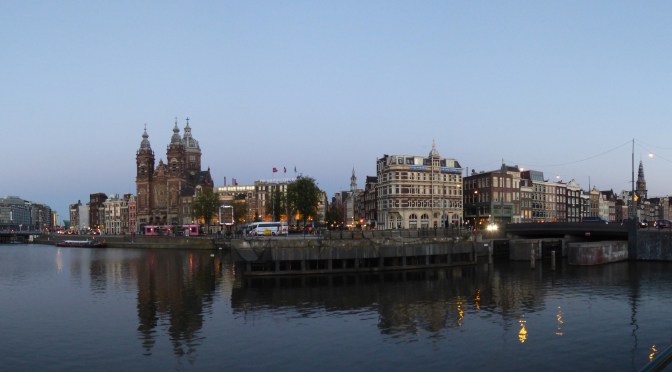
Netherlands, Belgium and Luxembourg – Spring 2015
This trip differed from previous European holidays in that it was largely self-directed, meaning no overall tour guide. Daily activities were planned on the fly. That being said, I made extensive use of local travel agencies to book day trips or local tours. In particular, I used City Sightseeing Hop on Hop off in both Amsterdam and Brussels and booked day trips to see anything I could not get to easily by local transport.
Favourite Moments
- Standing in Rembrandt’s studio enjoying a presentation on how Rembrandt would have mixed paint pigments.
- Taking in Rembrandt’s Night Watch at the Rijksmuseum in Amsterdam
- Sampling the wonderfully bizarre optical illusions at the Escher en het Palace Museum in the Hague
- Pondering Vermeer’s Girl with a Pearl Earring at the Moritzhous in the Hague
- Looking out from the Lion’s Mound over the Waterloo battlefield on the 200th anniversary of the 1815 battle.
- Standing on the balcony of the Zanse Chanse Windmill
- Strolling through the bizarre interior of the Atomium
Hotels:
- Hotel ibis Schiphol Amsterdam Airport (Amsterdam)
- This hotel is primarily oriented towards overnight stays and offers free transportation to Schippol Airport. I chose it partly to save money, but also because the airport has a major train station, which connects you to Amsterdam, Delft, the Hague, and many other popular destinations in the Netherlands.
- Hotel Floris Arlequin Grand Place (Brussels)
- The Floris Arlequin is only a short walk from Brussels central town square, the Grand Place, and an equally short walk from the central train station. Tucked away in an alley among Brussels’ galleria of restaurants, it offered a perfect location. The hotel and its amenities are basic.
Modes of transport: train, bus, boat, and foot:
Amsterdam: This is one of the easier European destinations to get around. Not only does it have a good public transit system, it also offers the usual tourist-oriented travel modes like hop on hop off with the added appeal of canal boat touring. Amsterdam has one of the most organized, and best-run train systems I have seen anywhere. The canal boat experience has an appeal that needs no explanation and is especially relaxing. Amsterdam is board flat, which makes it ideal for pedestrians, with one caveat: Amsterdam is also popular for cyclists. If you are on foot, you need to be careful of the bicycle lanes as cyclists tend to wail down the course like it’s the final lap of the Tour de France. They don’t have enough time to stop, and you likely won’t have much time to get out of the way – so be careful. Most of the major tourist attractions are within walking distance of each other, but you may appreciate the convenience of public transit to save your feet if nothing else. The one mode of transport I wouldn’t recommend for Amsterdam is the car. The roads are narrow, traffic is often congested and parking is extremely limited. If you simply must drive a car be prepared for some frustration.
Brussels: By comparison with Amsterdam, central Brussels will seem quite hilly. Additionally, its major tourist attractions are fairly spread out. You can walk to a lot of places, but you will really appreciate using some form of transport to cover longer distances. I used City Sightseeing hop on hop off for the first two days in Brussels and then used a combination of day trips and train travel for the rest. Brussels is a little more car-friendly than Amsterdam and offers the opportunity of day trips to the many beautiful towns nearby. However, the user-friendly Belgian train system has a terrific easy-to-use website, which makes it especially easy to visit the nearby towns. Belgium has two official languages, Flemish (Dutch) and Walloon (French), but English is spoken everywhere. Street signs are in one or both, and though I found the French slightly easier to read than the Dutch, you can navigate easily as long as you know the proper spelling of your destination.
 To the Ends of the Earth